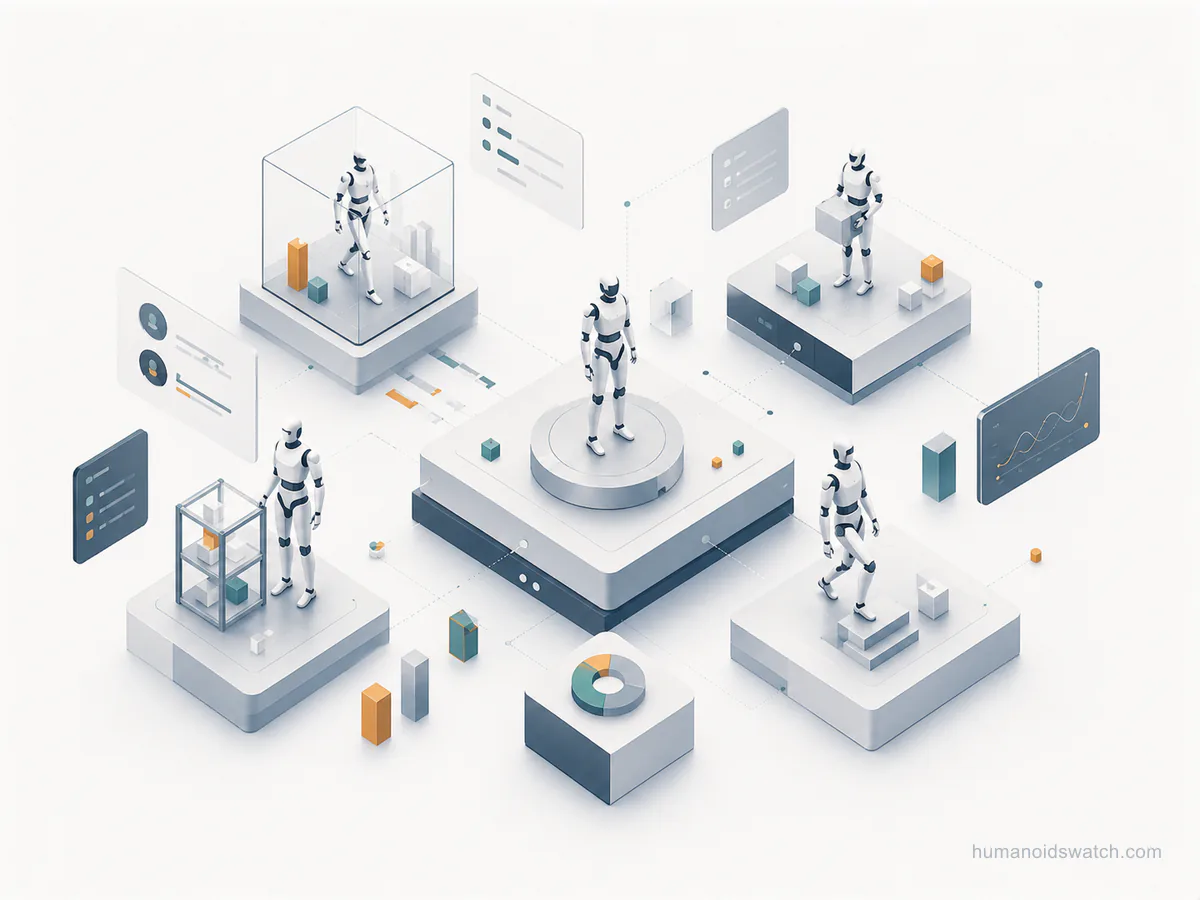
NVIDIA has announced NVIDIA Halos for Robotics, a safety system for robotics and physical AI that brings together compute, sensor connectivity, operating-system components, safety applications, and inspection support. The company frames it as a full-stack safety architecture for machines that sense, decide, and act in real environments.
For humanoid robotics, the important point is not only that NVIDIA is extending another platform into robotics. It is that safety is becoming a platform question. Buyers will not evaluate industrial humanoids only by walking stability, manipulation, or task demos. They will also ask whether the robot can be integrated into a safety case that operations, legal, insurance, and certification teams can actually inspect.
The first named humanoid signal is Agility. NVIDIA says Agility will incorporate NVIDIA IGX Thor and Halos Core into elements of Digit’s safety system and participate in the NVIDIA Halos AI Systems Inspection Lab. That makes Digit an important early reference point for the category, but it should not be read as evidence that all humanoid safety questions are now solved.
Why this matters beyond NVIDIA
Humanoid robots are moving into environments where conventional automation assumptions become harder to hold. A fenced robot arm can be isolated. An autonomous mobile robot can be constrained to mapped paths and speed zones. A humanoid operating around totes, carts, pallets, doors, racks, forklifts, and workers creates a different evaluation problem.
That problem is not just mechanical. It is system-level. A buyer needs to understand how perception failures are detected, how degraded sensor conditions are handled, how the machine transitions into a safe state, how human proximity is evaluated, and how the evidence trail will stand up during an internal safety review.
NVIDIA’s announcement positions Halos as a shared architecture for that problem. The stack is not presented as one isolated feature. It connects hardware, operating software, sensor data, safety applications, and inspection. If this approach gains traction, safety evidence may become more standardized across robot suppliers and deployment contexts.
That would matter for Humanoids Watch because our methodology treats buyer relevance as a function of evidence quality, not only technical ambition. A safety architecture that can be inspected, documented, and mapped to recognized standards is more useful to buyers than a general claim that a robot is “safe around people.”
What NVIDIA is actually packaging
The announcement describes several layers that together form the Halos for Robotics story.
- Platform compute and sensor connectivity: NVIDIA IGX Thor and Holoscan Sensor Bridge are positioned as the compute and sensor-connectivity foundation for robotics and safety workloads.
- Safety operating software: Halos OS and Halos Core provide the software foundation for safety-related operating functions, including Linux and Linux plus QNX configurations.
- Safety applications and blueprints: The Halos Outside-In Safety Blueprint extends robot perception beyond onboard sensors by using facility cameras, AI perception, and safety logic.
- Inspection support: The NVIDIA Halos AI Systems Inspection Lab is intended to help partners prepare Halos-based integrations for third-party certification activity.
The technical blog adds more detail on the architectural logic. NVIDIA is extending work from its autonomous vehicle safety stack into robotics, including functional safety processes, safety-assessed components, platform monitoring, and third-party assessment pathways. That is why this announcement should be read as a safety ecosystem move, not only a robotics product launch.
The availability signal is still early. NVIDIA says Halos Core for IGX is available in early access for registered developers, and the Outside-In Safety Blueprint is available as an early-access open-source project. The GitHub repository also describes the blueprint as an on-ramp for prototyping, evaluation, and integration development, not as a production safety layer by itself.
The Agility Digit signal
Agility is the strongest humanoid-specific part of the announcement. NVIDIA says Agility is the first company to use Halos for Robotics elements, integrating NVIDIA IGX Thor and Halos Core into its proprietary safe human detection system for Digit. NVIDIA also says Agility will use the inspection lab to evaluate Digit’s safety-related software, AI components, and cybersecurity protections against standards such as IEC 61508, ISO 13849, and ISO/IEC TR 5469 before final third-party certification.
For buyers, this is meaningful because Digit is aimed at industrial workflows where safety evidence is not optional. Warehouses and factories are full of shared-space edge cases: temporary obstructions, workers entering zones unexpectedly, forklift traffic, trailer-loading constraints, and changing lighting conditions. Those are exactly the conditions where a humanoid needs more than a polished demo.
But the signal has limits. The announcement does not prove certified large-scale humanoid deployment. It does not provide incident-rate data, throughput data, integration cost, customer acceptance metrics, or deployment-by-deployment safety outcomes. It says that a prominent humanoid supplier is adopting parts of a safety architecture and entering an inspection pathway.
That is still important. It gives buyers a more concrete due-diligence direction: not just “Can Digit do the task?” but “Which parts of the safety case are covered by the robot, which by the NVIDIA stack, which by the facility, and which still belong to the integrator or buyer?”
Why outside-in safety is a buyer-relevant idea
One of the more interesting concepts in the announcement is outside-in safety. Traditional robot safety often begins with the robot’s own sensors. That remains necessary, but it can be insufficient in industrial spaces with occlusions, blind corners, variable lighting, high racks, trailers, and moving equipment.
Outside-in safety adds fixed infrastructure cameras and AI perception around the workspace. The idea is that a robot does not rely only on what it can see from its own body. The facility can become part of the safety system by monitoring regions of interest, detecting people or objects, and sending safety-relevant signals that influence robot behavior.
In a warehouse setting, this could matter most where robots and people intersect in narrow or partially visible zones. NVIDIA’s reference example focuses on automated trailer loading, where outside-in monitoring can help decide when a loading area is clear and when onboard safety constraints should remain active.
For humanoid deployments, the broader implication is that the facility may increasingly become part of the robot system. A buyer may not be purchasing only a robot. They may be evaluating a combined architecture of robot, sensors, compute, safety software, site integration, validation workflow, and certification documentation.
That makes the comparison between humanoid vendors more complex. A robot with strong onboard capability but weak integration evidence may be less attractive than a robot that fits into a more inspectable site-level safety architecture. The next phase of humanoid competition may therefore include safety-system compatibility, not only physical performance.
What this does not prove yet
The central risk is over-reading the announcement. A platform safety architecture can make evidence easier to organize, but it does not remove the hard work of validating a specific robot in a specific operating environment.
That distinction matters because humanoid robotics is still full of vocabulary that can sound stronger than the evidence behind it. “Safe,” “industrial-ready,” “autonomous,” and “certification-ready” are not the same claim. A useful buyer conversation needs to separate architecture, component readiness, third-party inspection, final certification, customer deployment, and measured operating performance.
NVIDIA Halos for Robotics improves the vocabulary around those questions. It does not automatically answer them.
A likely market effect: safety claims become more comparable
If NVIDIA succeeds, Halos could make safety discussions more comparable across robot makers, system integrators, and industrial customers. That would be a meaningful shift. Today, many humanoid claims are difficult to compare because each vendor describes safety, autonomy, and deployment readiness in its own language.
A shared stack, recognized inspection process, and common standards mapping could reduce that ambiguity. Buyers could ask whether a robot uses Halos components, whether its integration has gone through the inspection lab, what scope was inspected, which third-party certification body is involved, and what remains outside the inspected boundary.
This does not mean NVIDIA controls the whole robotics market. Robot OEMs still own core design decisions. Integrators still need to fit systems into the customer site. Buyers still need local safety validation. But it does suggest that safety infrastructure may become a competitive layer in physical AI.
For humanoid vendors, the announcement raises the bar. A general safety statement may become less persuasive when competitors can point to a named safety stack, inspection pathway, standards alignment, and site-level perception architecture. The market may start asking for more explicit evidence.
The buyer questions that matter now
For industrial buyers, NVIDIA Halos for Robotics should trigger a more precise due-diligence checklist.
- Which parts of the robot’s safety case depend on onboard sensing, and which depend on facility-level sensors?
- Is the safety architecture inspected, certified, or only described as certification-ready?
- Which standards are in scope, and which parts of the system are excluded from that scope?
- What happens when perception confidence degrades, lighting changes, a camera is blocked, or the network drops?
- Who owns the final safety case: the robot vendor, NVIDIA, the system integrator, or the buyer?
- What evidence exists beyond the architecture itself, including uptime, intervention rates, incident history, and deployment-specific validation?
The announcement is an important signal because it moves the humanoid conversation toward evidence that buyers can actually evaluate. The next proof point will not be whether the architecture sounds comprehensive. It will be whether real deployments can use it to produce safer, more inspectable, and more repeatable operations.