Robotera
Robotera L7
Analyst summary
At a glance
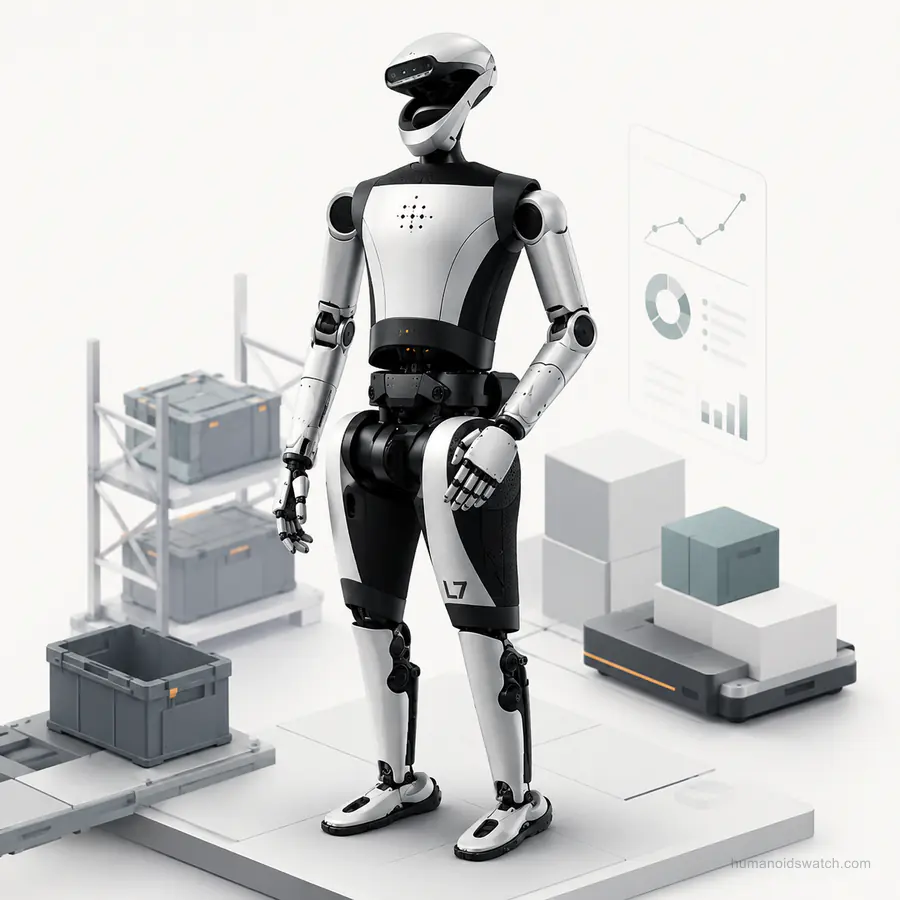
Robotera L7 is a bipedal humanoid robot from Robotera, a Tsinghua University spinoff, positioned for industrial manipulation and high-agility tasks. It has 55 DoF, a 20 kg payload, and 4.0 m/s running speed. Teleoperated demos at CES 2026 showed dynamic motion and manipulation. No customer deployments are disclosed, and pricing is unpublished.
Evidence signal
Deployments
0 linked deployments
No published deployments are linked to this robot yet.
Profile basics
Specifications
- Robot type
- Full-size bipedal humanoid
- Height
- 1.71 m
- Weight
- 70 kg
- Payload
- 20 kg
- Speed
- 4.0 m/s
- Runtime
- n/a
- Locomotion
- Bipedal
- Manipulation
- Two arms with hands
- Degrees of freedom
- 55 DoF
- Autonomy / control
- Teleoperated
Profile context
Description
The Robotera L7 is a full-size bipedal humanoid robot developed by Robotera, a Beijing-based robotics company spun out of Tsinghua University. Standing 1.71 m tall and weighing 70 kg with 55 degrees of freedom, the L7 combines dynamic whole-body motion with fine manipulation. The robot has drawn attention for high-speed running at a reported 4.0 m/s and for dexterous hands demonstrated through full-body teleoperation. Robotera positions the L7 within a broader Hexa-Core hardware lineup that includes the Q5 wheeled humanoid and the XHAND1 dexterous hand. At CES 2026, the Robotera L7 was shown executing teleoperated tasks in a controlled exhibition environment rather than autonomous operation. The company reports over 600 cumulative unit deliveries across its product range, though L7-specific deployment figures are not separately disclosed.
Public deployment evidence for the Robotera L7 remains limited. The robot's most visible appearance was a teleoperated demonstration at CES 2026, where it showcased dynamic locomotion and manipulation in a controlled exhibition setting. Robotera reports cumulative deliveries of over 600 units across its hardware portfolio, but this aggregates all products including the Q5 wheeled platform and XHAND1 hand, and does not distinguish L7-specific commercial placements. No named customer deployments, production pilots, or operational field sites have been publicly disclosed. The robot was operated via human teleoperation rather than autonomous task execution, placing its demonstrated maturity at the demo stage. Buyers should distinguish between the vendor's strong technical positioning and the absence of named, repeatable field deployments.
The Robotera L7 may be most relevant for organizations evaluating high-agility humanoid robots for industrial manipulation, logistics, or research where speed and dynamic motion are priorities. Its reported 4.0 m/s running speed and 55 degrees of freedom suggest a platform emphasizing athletic motion alongside tasks such as sorting, assembly, and handling. The dual-arm payload of 20 kg places the L7 in a moderate lifting category among humanoids in development. Buyers should note that runtime and pricing remain unpublished, and public demonstrations have relied on teleoperation, meaning the autonomy picture is not yet buyer-ready. The Robotera L7 appears better suited to research labs and advanced automation evaluation teams than to buyers seeking a mature, deployment-proven robot. Practical assessment depends on whether Robotera can transition from teleoperated demos to autonomous operating use in real industrial environments.