Reflex Robotics
Reflex
Analyst summary
At a glance
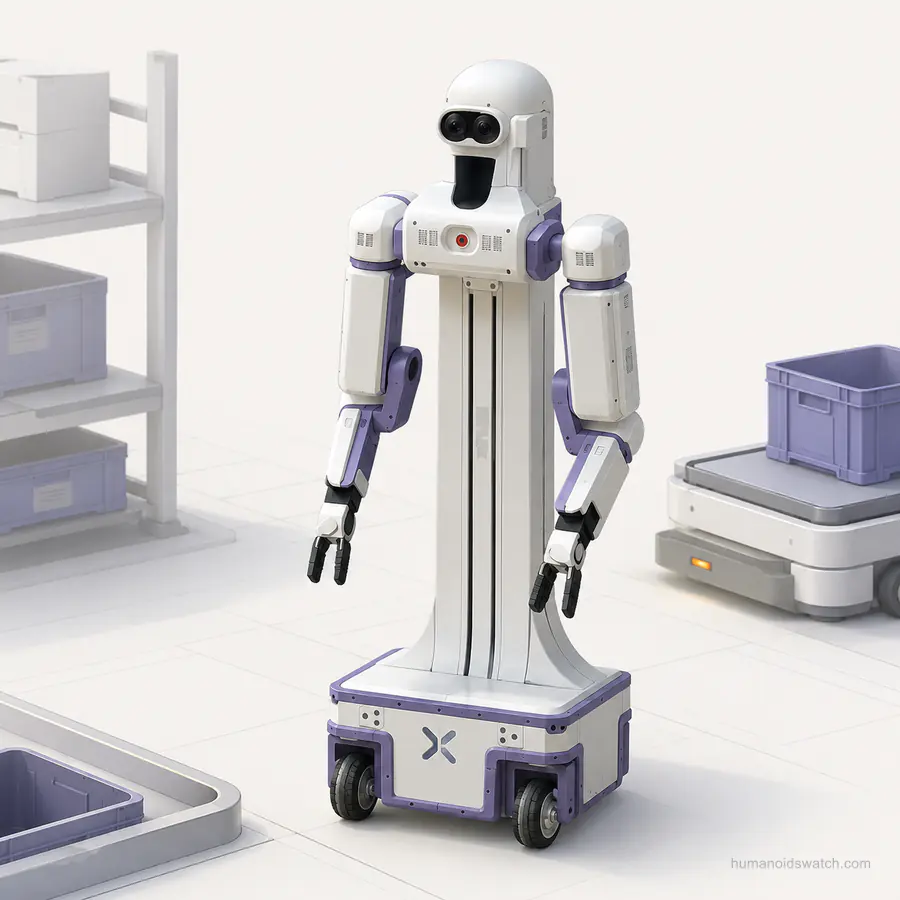
Reflex is a wheeled humanoid mobile manipulator from Reflex Robotics for warehouse picking and palletizing. It pairs a height-adjustable torso with a compact wheeled base, relies on teleoperation with AI learning from human demonstrations, and is priced under $50,000 — among the most aggressive pricing among humanoid robots in warehouse logistics.
Evidence signal
Deployments
0 linked deployments
No published deployments are linked to this robot yet.
Profile basics
Specifications
- Robot type
- Humanoid mobile manipulator
- Height
- n/a
- Weight
- n/a
- Payload
- 22.7 kg
- Speed
- n/a
- Runtime
- 16+ h
- Locomotion
- Wheeled
- Manipulation
- Two arms with hands
- Degrees of freedom
- n/a
- Autonomy / control
- Semi-autonomous / assisted autonomy
Profile context
Description
Reflex by Reflex Robotics is a wheeled humanoid robot designed for structured warehouse and logistics environments. Unlike legged humanoid robots, Reflex uses a compact wheeled base paired with a height-adjustable torso and two arms with swappable three-finger grippers. The robot is primarily teleoperated at a 1:1 ratio while the system learns from human demonstrations to build toward greater autonomy. Reflex Robotics is a New York-based startup founded by MIT alumni, backed by Khosla Ventures. The robot drew attention at Modex 2024 in Atlanta with a live pick-and-place demo, with the vendor describing it as approaching human-level efficiency in repetitive warehouse workflows. As one of the more compact and lower-cost humanoid robots, Reflex prioritizes stability and affordability over bipedal complexity.
Public deployment evidence for Reflex remains limited but is developing. At Modex 2024, Reflex Robotics showed a live second-generation system performing pick-and-place tasks — a controlled trade-show demonstration, not a production deployment. The vendor reported selective pilots with potential customers, including unnamed large logistics operators, and has publicly referenced GXO as a pilot partner. The startup's timeline, as stated by its CEO in early 2024, projected a ramp from 10–20 robots to hundreds in the following year. In warehouse logistics, a wheeled humanoid mobile manipulator faces competition from established autonomous mobile robots and piece-picking systems as well as from other humanoid robots targeting the same workflows. Buyers should assess whether Reflex has moved beyond initial pilots into repeatable multi-shift operation and whether independent performance data exists beyond vendor claims.
Reflex may be most relevant for buyers evaluating lower-cost humanoid robots for structured warehouse tasks such as shelf picking, palletizing, and tote handling. Its wheeled base and compact footprint suit facilities with flat floors and narrow aisles where bipedal humanoids add unnecessary complexity. The 22.7 kg collective payload and 16-plus-hour runtime align with multi-shift logistics operations, and the reported 60-minute deployment window suggests relatively low integration burden. The under-$50,000 price point positions Reflex below many competing humanoid robots, though teleoperation dependency means a 1:1 human-to-robot supervision ratio in the near term, limiting labor displacement economics. Practical assessment should focus on whether the autonomy roadmap delivers meaningful reduction in operator oversight, whether reliability meets warehouse uptime expectations, and whether the vendor can support production volumes.