Svaya Robotics
Bimanual
Analyst summary
At a glance
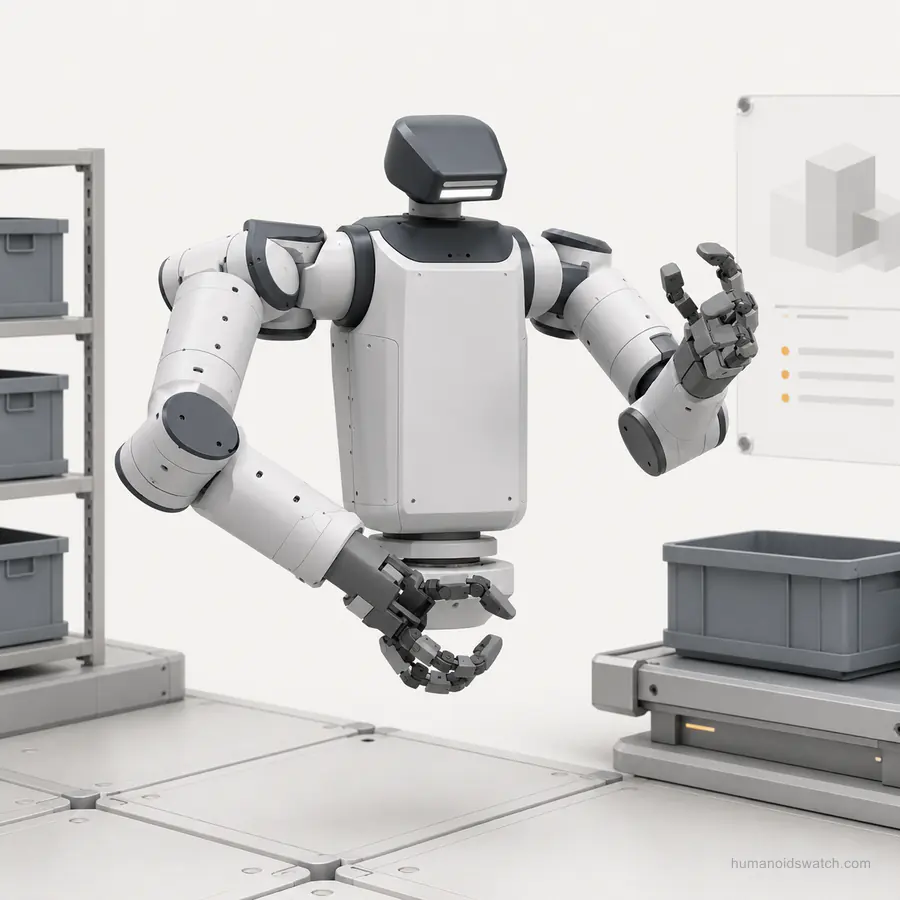
Bimanual is a stationary upper-body humanoid robot from Svaya Robotics, positioned for dexterous manipulation and precision assembly in industrial settings. Built on the vendor's collaborative robot platform, it combines dual 7-DoF arms, 360-degree base rotation, and whole-body force control to handle tasks in semi-structured environments.
Evidence signal
Deployments
0 linked deployments
No published deployments are linked to this robot yet.
Profile basics
Specifications
- Robot type
- Full-size bipedal humanoid
- Height
- n/a
- Weight
- n/a
- Payload
- n/a
- Speed
- n/a
- Runtime
- n/a
- Locomotion
- Stationary
- Manipulation
- Two arms, end effectors not disclosed
- Degrees of freedom
- 14 DoF
- Autonomy / control
- Semi-autonomous / assisted autonomy
Profile context
Description
Bimanual by Svaya Robotics is a stationary upper-body humanoid robot designed around a bimanual manipulation concept, with two 7-DoF arms mounted on a 360-degree rotating torso base. Svaya Robotics, an India-based automation company, developed Bimanual using its vertically integrated approach to actuators, controls, and perception software. The robot is presented as a dexterous manipulation platform for manufacturing applications, with modular end-effector wrists, integrated vision, and whole-body force control. Compared to full-size mobile humanoid robots, Bimanual takes a narrower functional approach — it trades locomotion for precision and repeatability at a fixed workstation. Public information about its autonomy level, production maturity, and commercial availability remains sparse.
Public deployment evidence for Bimanual is very limited. Svaya Robotics positions the robot as a development platform for building atomic AI skills toward general-purpose manipulation, and the company's public product page describes its mission in aspirational terms — 'to make them truly general-purpose' for work in less structured environments. No named customer deployments, pilots, or commercial rollout announcements are clearly disclosed. The vendor's emphasis on in-house manufacturing, modular design, and software-defined architecture suggests a pre-commercial platform still maturing toward repeatable field use. Buyers assessing Bimanual should distinguish between the vendor's technical capability in collaborative robotics — where Svaya has proven experience — and the specific deployment readiness of this humanoid platform, which lacks visible operating evidence beyond internal demonstrations.
Bimanual may be most relevant for buyers exploring stationary dexterous manipulation in manufacturing lines where a fixed-location humanoid robot can complement existing automation. Its dual-arm design and 360-degree reach suit precision assembly, pick-and-place, and machine-tending workflows that require human-like dexterity without mobile navigation. The modular wrist and open interface for end-of-arm tooling add flexibility for switching between tasks. Buyers should evaluate Bimanual against conventional dual-arm industrial robots and mobile humanoid robots alike — the stationary form factor limits operational range but may reduce integration complexity and cost. With pricing estimated around $90,000 by third-party sources and no vendor-confirmed specifications for payload, speed, or runtime, practical assessment depends on direct engagement with Svaya Robotics for production-ready details.