ROBOTIS
AI Worker
Analyst summary
At a glance
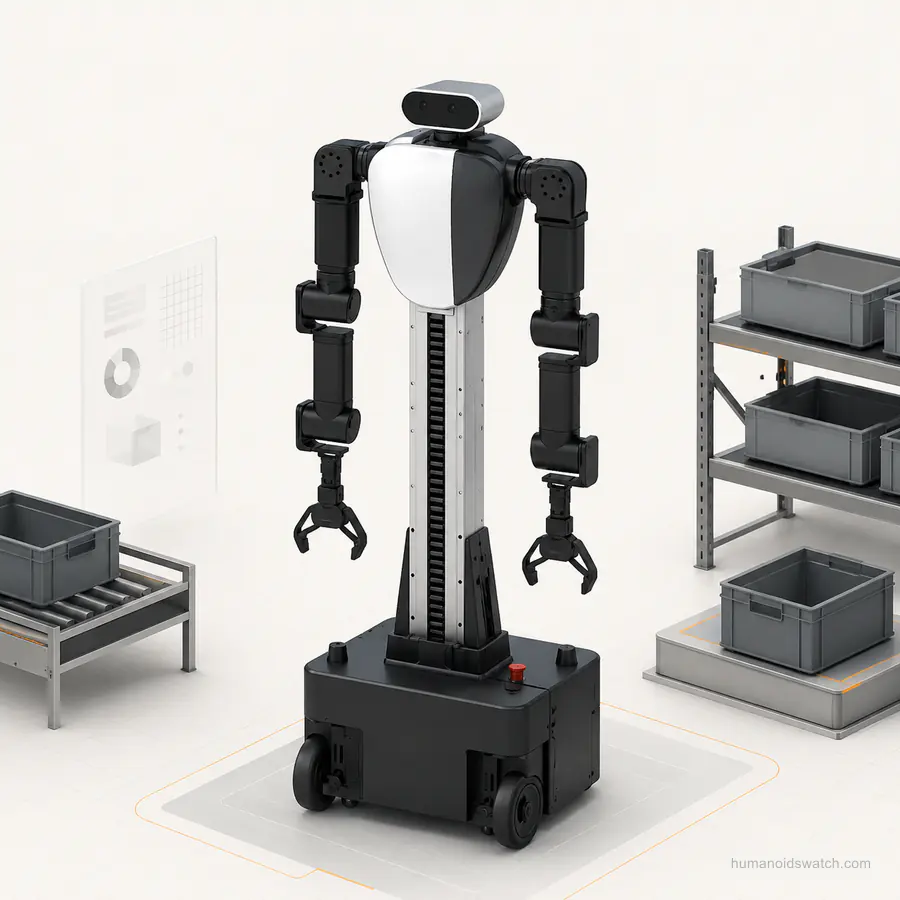
The AI Worker by ROBOTIS is a semi-humanoid industrial robot on a swerve-drive mobile base with dual 7-DOF arms, positioned for imitation-learning-driven manipulation in assembly and inspection. It offers a capable open-source hardware platform, though named customer deployments and a defined commercial procurement path remain unconfirmed.
Evidence signal
Deployments
0 linked deployments
No published deployments are linked to this robot yet.
Profile basics
Specifications
- Robot type
- Semi-humanoid service robot
- Height
- 1.62 m
- Weight
- 90 kg
- Payload
- 3 kg
- Speed
- 1.5 m/s
- Runtime
- n/a
- Locomotion
- Wheeled
- Manipulation
- Two arms with grippers
- Degrees of freedom
- 25 DoF
- Autonomy / control
- Task-level autonomy
Profile context
Description
The AI Worker is a semi-humanoid robot developed by ROBOTIS, a South Korean firm well known for its DYNAMIXEL actuator ecosystem and open-source robotics platforms. The robot combines an upper-body torso with dual 7-DOF manipulator arms and a swerve-drive mobile base, placing it at the intersection of humanoid robots and wheeled industrial mobile manipulators. Onboard compute is provided by an NVIDIA Jetson AGX Orin, and the perception suite includes stereo depth cameras and LiDAR sensors. ROBOTIS positions the AI Worker for industrial tasks such as wiring harness assembly, welding, and inspection, with an emphasis on imitation learning as the primary skill-acquisition method. The full platform is documented and made available as open-source hardware and software, which is an unusual and notable posture in the commercial humanoids segment.
Public deployment evidence for the AI Worker remains limited. ROBOTIS has published detailed hardware specifications and demonstration materials, and the platform is marketed clearly toward industrial use, but named customer deployments, pilot programs, or commercial rollouts are not publicly confirmed at this time. The robot's open-source model suggests a developer-and-researcher engagement strategy rather than a near-term production-deployment push, which is a different go-to-market profile than that of competitor robots pursuing direct factory integration. The public record is stronger on technical platform positioning than on field deployment, and buyer assessment should focus on whether the AI Worker has moved beyond laboratory and demo-stage operation into repeatable industrial use.
The AI Worker may be most relevant for industrial automation teams, research labs, and integrators evaluating imitation-learning-based manipulation on a wheeled semi-humanoid platform. Its swerve-drive mobility makes it well suited to indoor logistics and workstation-based tasks on flat floors, while the dual-arm configuration addresses two-handed manipulation use cases. The 3 kg nominal single-arm payload limits applicability to light assembly and inspection workflows rather than heavy part handling. Pricing is not publicly listed and appears to be available only through enterprise contact, which introduces procurement uncertainty. Buyers should evaluate whether the open-source platform approach and imitation-learning workflow fit their integration capabilities, and whether the limited public deployment evidence aligns with their operational readiness requirements.